Generating multiple test fit scenarios is now a key part of early-stage real estate feasibility study workflows. But the value of a test fit is not simply in how many options are created. The value comes from how well those options are evaluated.
In many cases, development teams compare options based on unit count, visual layout, or which scheme "looks" most efficient. However, a strong development feasibility study requires a more analytical framework. Density, efficiency, parking, zoning flexibility, and buildability all influence whether a scenario is actually viable.
Below are the key factors developers and architects should evaluate when comparing test fit scenarios during site feasibility analysis.
1. Density and Efficiency Must Be Evaluated Together
Higher density often looks attractive during the early stages of a real estate feasibility study. More units can suggest higher revenue potential, stronger land utilization, and better overall yield.
However, density does not automatically equal feasibility.
The Urban Land Institute's report, The Economics of Inclusionary Development, explains how development feasibility depends on the relationship between density, construction cost, incentives, and project economics. In other words, additional density can improve feasibility in some cases, but only when the added value outweighs the added complexity.
When comparing test fit options, developers should look at:
• Total unit count
• Floor Area Ratio (FAR)
• Gross floor area
• Net rentable area
• Efficiency rate
A higher-density option may underperform if it creates inefficient layouts, excessive circulation, or construction complexity. In a strong development feasibility study, density should always be evaluated alongside efficiency.
2. Layout Efficiency Drives Real Project Value
Not all square footage contributes equally to revenue.
Two test fit scenarios may have similar gross floor area but very different usable or rentable area. One layout may require longer corridors, awkward unit shapes, or inefficient floor plates. Another may produce cleaner stacking, better unit distribution, and more efficient circulation.
This matters because layout efficiency directly affects financial performance during a real estate feasibility study. A scenario with slightly fewer units but better efficiency may produce stronger returns than a denser scheme with more wasted space.
When reviewing layout efficiency, teams should evaluate:
• Circulation space
• Unit stacking
• Repetition across floors
• Core placement
• Floor plate usability
A strong test fit is not just the one that fits the most program onto the site. It is the one that uses the building area most effectively.
3. Parking Can Change the Entire Feasibility Outcome
Parking is often one of the most underestimated constraints in land development.
A test fit may appear strong from a density perspective, but parking requirements can quickly change the outcome. Parking affects building layout, podium size, circulation, construction cost, and sometimes the total number of units that can realistically be supported.
The American Planning Association notes that parking requirements can increase housing costs, reduce land available for housing, and limit more varied development types in its article, The Push for Parking Reform.
NAIOP also highlights the cost impact of parking, noting that surface parking can cost approximately $3,000 to $8,000+ per space, while multilevel parking structures can cost $25,000 to $100,000+ per space, before land and operating costs are considered. Rightsizing Parking in Support of Sustainability and ROI.
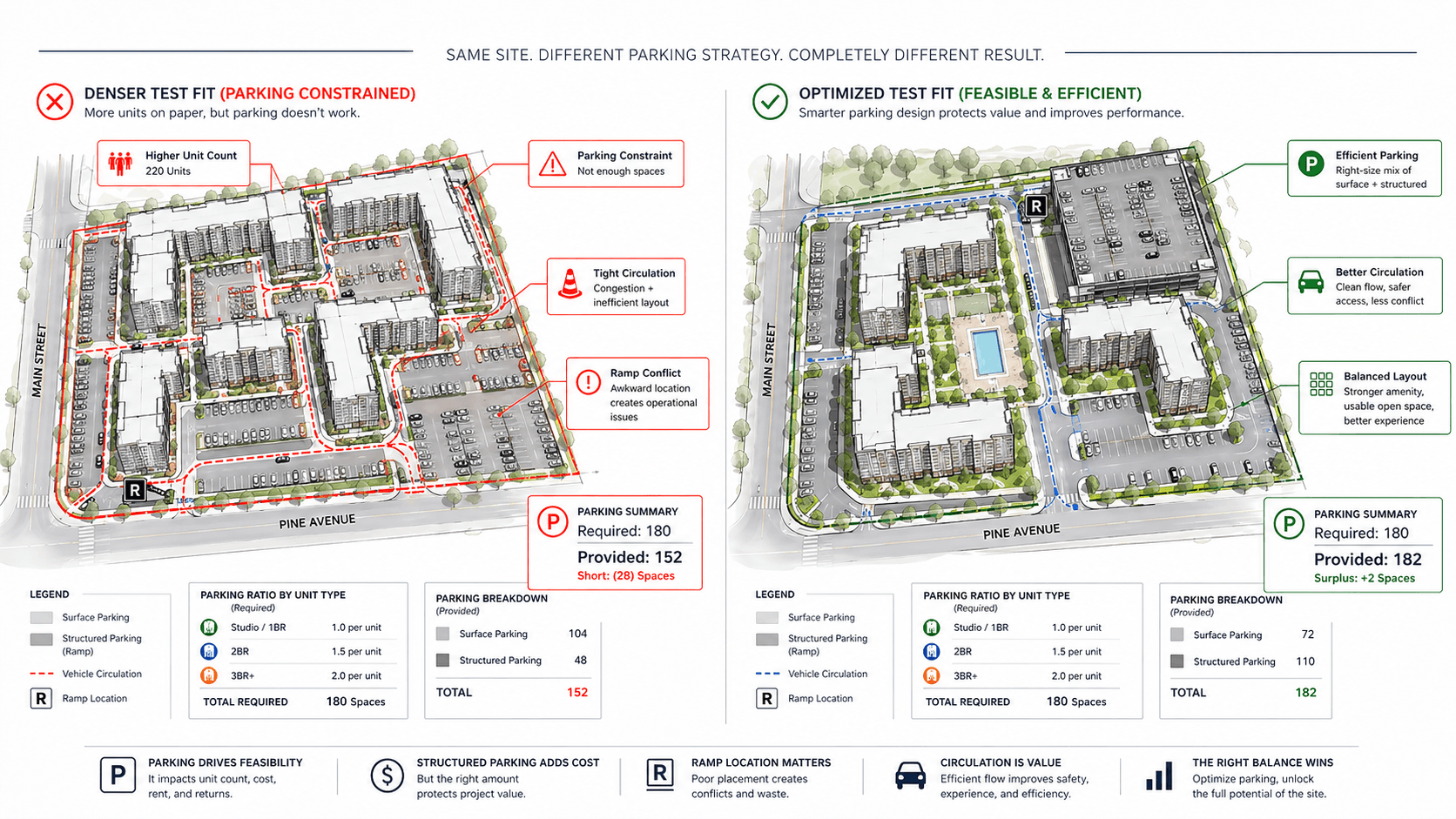
When comparing test fit scenarios during site feasibility analysis, developers should review:
• Required parking count
• Provided parking count
• Parking ratio by unit type
• Surface vs structured parking
• Ramp placement
• Vehicle circulation
In many cases, the best test fit is not the one with the highest unit count. It is the one that solves parking most efficiently while preserving project value.
4. Zoning Flexibility Can Improve or Limit the Best Scenario
Zoning does more than define what can be built. It shapes the range of feasible outcomes.
Setbacks, height limits, density caps, open space requirements, and parking minimums all influence the final test fit. A layout may appear strong in isolation, but once zoning constraints are applied, the buildable area may shrink or the project may require a different unit mix.
The American Planning Association's article, What Is Zoning Reform and Why Do We Need It?, explains how zoning rules such as minimum lot sizes, limits on smaller units, and parking minimums can affect housing production and development cost.
During a development feasibility study, zoning should be evaluated as an active design constraint, not just a checklist item.
Key zoning factors to compare include:
• Setbacks
• Height limits
• FAR
• Density allowances
• Parking requirements
• Open space requirements
• Bonus or incentive pathways
A strong test fit uses zoning constraints strategically rather than simply reacting to them.
5. Buildability Is Where Many Test Fits Fail
Some test fit scenarios look strong during early modeling but become difficult to execute in practice.
Common buildability issues include:
• Irregular parcel geometry
• Tight setbacks
• Sloped terrain
• Difficult site access
• Utility conflicts
• Inefficient structural layouts
This is why site feasibility analysis should not only ask, "Can the program fit?" It should also ask, "Can this realistically be built?"
A strong test fit must balance design potential with construction practicality. If a scenario requires excessive grading, complicated circulation, or inefficient structural logic, it may be weaker than a simpler option with slightly less density.
6. Financial Sensitivity Matters More Than One Perfect Scenario
A common mistake in a real estate feasibility study is selecting the option with the strongest projected return under one fixed assumption set.
But real estate assumptions change.
Rents shift. Construction costs move. Parking requirements change. Unit mix assumptions get refined. Capital markets tighten or loosen.
Because of this, developers should compare how each test fit performs under different assumptions.
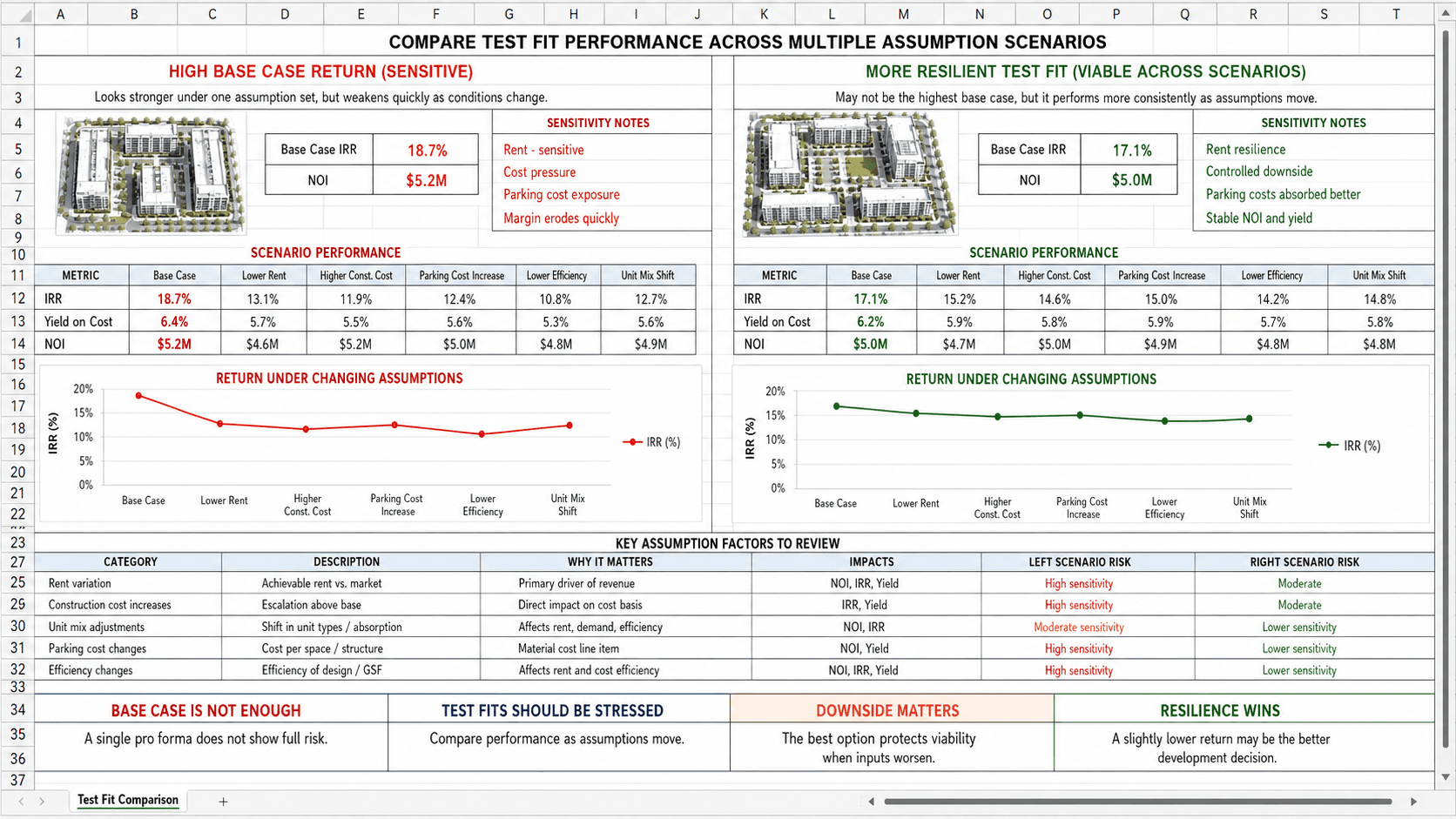
Useful sensitivity checks include:
• Rent variation
• Construction cost increases
• Unit mix adjustments
• Parking cost changes
• Efficiency changes
• Yield and NOI impact
The strongest test fit is not always the one with the highest theoretical return. It is often the one that remains viable across multiple scenarios.
7. The Best Test Fit Balances Multiple Metrics
A strong test fit is not defined by one metric.
It is the scenario that best balances:
• Density
• Efficiency
• Parking
• Zoning compliance
• Buildability
• Financial performance
This is why comparing multiple options is so important. A single layout may answer whether something can fit. Multiple layouts reveal which option performs best and why.
In a well-structured development feasibility study, each test fit should be evaluated as part of a broader decision-making process, not as a standalone design exercise.
Why This Matters
The purpose of a real estate feasibility study is not to produce one attractive layout.
It is to understand the range of possible outcomes and identify the option that best supports the project's goals.
By comparing test fit scenarios analytically, developers and architects can make better decisions earlier in the process. They can identify where density helps, where efficiency breaks down, where parking becomes costly, and where zoning or site constraints may limit the project.
That is what turns a basic test fit into a meaningful site feasibility analysis.
Explore What Zenerate Can Do
If you would like to discuss how Zenerate could support your feasibility or land development workflow, book a demo below to start the conversation.