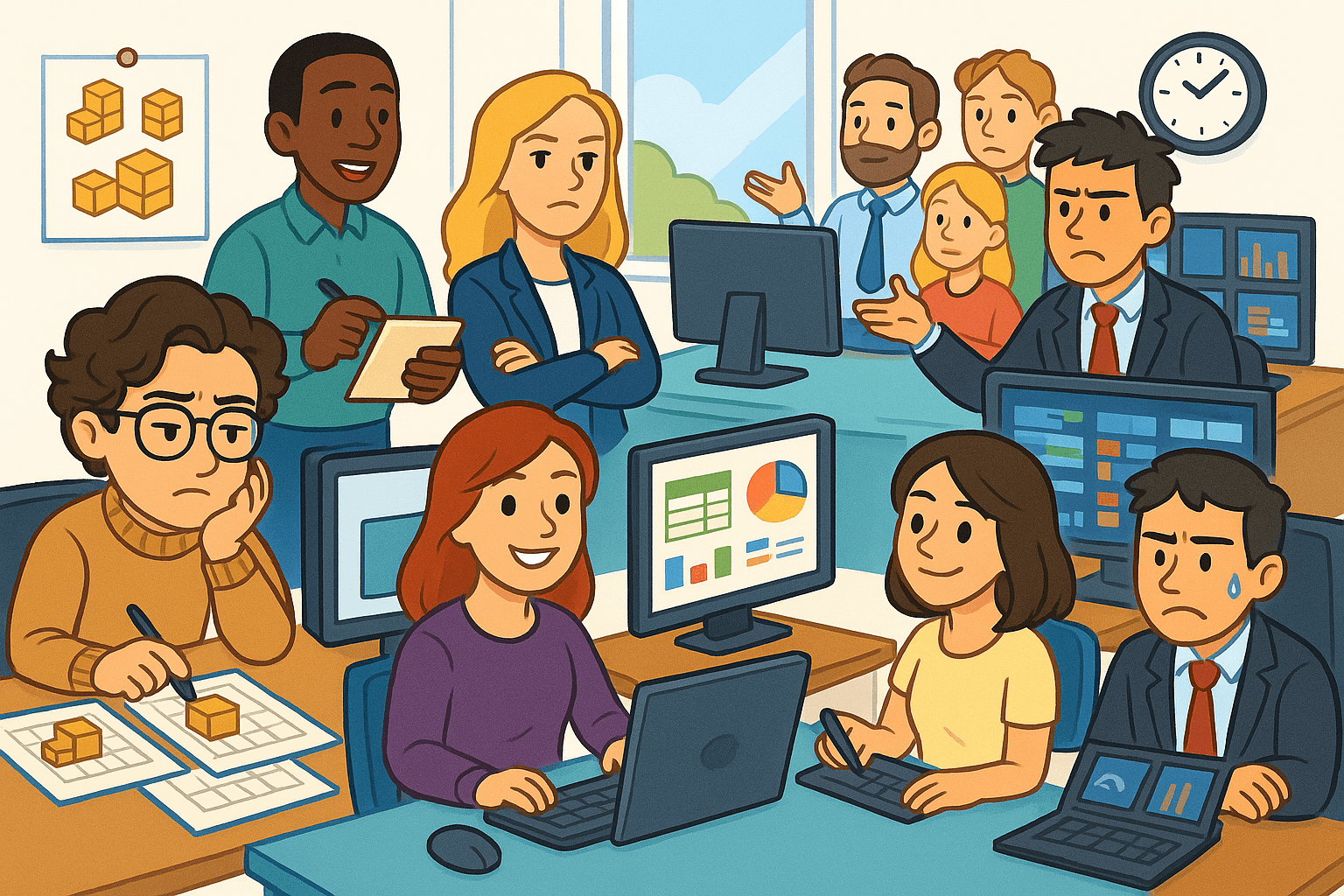
Every architect and developer has a distinct way of approaching early-stage feasibility. Some thrive in spreadsheets, others in massing studies, and some prefer to "feel" the site like an urban oracle.
Whichever camp you fall into, your iteration style says more about your workflow—and your project outcomes—than you might expect.
Here's a lighthearted look at the unofficial "personality types" of development teams, and how real-time feasibility tools elevate every one of them.
1. The Overthinker
You don't generate one massing study—you generate thirty.
You test setbacks, FAR, height, shadow, orientation… and then circle back to the first option because "it had potential."
You know every zoning subsection better than you know your friends' birthdays.
Strengths: thoroughness, accuracy
Weaknesses: time blindness, existential zoning crises
Natural habitat: a desktop with 18 feasibility PDFs open
How real-time feasibility helps:
Instant scenario testing means you can explore every idea without losing a week in the process. Your overthinking becomes your superpower instead of your bottleneck.
2. The One-and-Done
You believe in your first idea with the kind of conviction normally reserved for Olympic athletes.
Version 1 is your north star.
Version 2 is an insult.
Strengths: decisiveness, clarity
Weaknesses: allergic reactions to revisions
Natural habitat: a single, beautifully organized folder titled "FINAL"
How real-time feasibility helps:
You get immediate validation for your first instinct—and quick feedback if something needs adjusting. No long back-and-forth. No waiting on consultants. Just truth, fast.
3. The Spreadsheet Wizard
Your brain is 50% creativity, 50% Excel formulas.
You don't need coffee—you run on conditional formatting.
You have strong opinions about unit mix percentages and amortization tables.
Strengths: numerical precision, financial clarity
Weaknesses: prone to disappearing into a VLOOKUP rabbit hole
Natural habitat: dual monitors, one for modeling and one for dashboards
How real-time feasibility helps:
Auto-calculated FAR, yield, GFA, and mix breakdowns give you clean numbers instantly—freeing your mind for higher-level strategy instead of manual math.
4. The Endless Masser
Your favorite phrase is: "What if we rotate the building just 3 degrees?"
Your second favorite is: "Actually… what about 2 degrees?"
You love exploring form—and your render folder is a museum of ideas.
Strengths: creativity, spatial intuition
Weaknesses: prone to over-iteration, existential crises about angles
Natural habitat: Sketchup, Rhino, and a folder titled "Concept_Concept_FINAL_v7"
How real-time feasibility helps:
Change the geometry, see the numbers update instantly. No waiting for teams, no recalculation delays—just pure creative flow.
5. The Site Whisperer
You walk the land and instantly know where the building wants to be.
You read slope data like tea leaves.
GIS is your tarot deck.
Strengths: intuitive design, contextual sensitivity
Weaknesses: occasionally skips the math until later
Natural habitat: on-site with a notebook, pointing at things with deep meaning
How real-time feasibility helps:
Your instincts pair with a data-backed platform that confirms (or challenges) your ideas in real time. Intuition + analytics = unbeatable site strategies.
6. The Committee of Everyone
Your workflow relies on:
• acquisition
• design
• finance
• ISF
• leadership
• that one person who always joins late but has the strongest opinions
You're basically running a feasibility democracy.
Strengths: collaboration
Weaknesses: decision paralysis
Natural habitat: Teams calls with 8 people talking at once
How real-time feasibility helps:
Shared, live models ensure everyone sees the same constraints, same numbers, same outputs—so alignment happens much faster.
7. The Crisis Fixer
You don't start feasibility until the last possible moment.
But when you do, it's a 48-hour sprint fueled by adrenaline and takeout.
You are the emergency room doctor of development.
Strengths: speed, intensity
Weaknesses: stress, stress, stress
Natural habitat: a dark room with four screens and a countdown clock
How real-time feasibility helps:
Rapid modeling means the "last-minute scramble" becomes a manageable process instead of a crisis.
So… Which One Are You?

Whatever your personality, your workflow improves when feasibility becomes real-time.
Faster scenarios, clearer numbers, fewer delays, and more confident decision-making.
Real-time feasibility doesn't replace your style—it supercharges it.
Ready to see your workflow at its best?
Explore how real-time feasibility elevates every type of developer and design thinker.