Early-stage land planning often begins with a simple question:
What can this site realistically support?
For architects, developers, and real estate teams, answering that question usually requires testing multiple site planning scenarios, comparing density options, reviewing circulation, and understanding parking requirements before a project moves forward. This process is especially important during land acquisition, when teams need to evaluate site potential quickly and confidently.
For Pivotal Architecture, a Denver-based architecture and land planning firm, Zenerate helped accelerate that early feasibility process.
Using Zenerate, Pivotal Architecture rapidly generated and evaluated two parallel development concepts for a suburban site in the Denver metropolitan area: a townhome concept and an active adult apartment/condominium concept. The goal was to create marketing material for a large, established real estate company presenting potential land acquisition opportunities.
Instead of spending days manually drafting initial site plans, Pivotal Architecture was able to generate multiple development scenarios and evaluate potential unit yield, circulation, and parking strategies in a matter of hours.
About Pivotal Architecture
Pivotal Architecture, PC is an architecture and land planning firm based in Denver, Colorado. The firm specializes in housing design, including affordable housing, workforce housing, townhomes, senior housing, and mixed-density residential developments.
Much of Pivotal Architecture's work begins at the land planning and feasibility stage, where the team helps developers and real estate groups understand how a site can realistically be developed.
The firm works closely with developers, housing organizations, and real estate teams to translate site constraints into feasible and cost-effective development strategies. These constraints often include density, circulation, parking, zoning, site layout, and overall project feasibility.
By focusing on meaningful, well-planned, and thoughtfully designed communities, Pivotal Architecture helps clients move from early site evaluation to clearer development direction.
The Challenge: Evaluating Site Potential Quickly
At the earliest stages of a project, development teams often need to understand what a site can support before making larger acquisition, design, or investment decisions.
For this suburban Denver metropolitan area site, Pivotal Architecture needed to evaluate multiple residential development strategies and communicate the site's potential clearly. The team prepared two parallel concepts:
• A lower-density townhome concept
• A higher-density active adult apartment/condominium concept
Each scenario required more than a basic site sketch. The team needed to understand building placement, circulation, parking distribution, unit yield, and overall site organization.
In a traditional workflow, producing these early site planning options manually can take days. Each alternative requires drafting, adjusting layouts, checking circulation, revising parking, and preparing visuals that are clear enough for client conversations.
For land acquisition decisions, that timing matters. Developers and real estate teams often need to compare options quickly, especially when evaluating whether a site is worth pursuing.
The Workflow: Using Zenerate for Early Feasibility Testing
Pivotal Architecture used Zenerate during the earliest stages of project feasibility and land evaluation.
The platform allowed the team to explore different site planning scenarios that tested housing types, densities, circulation strategies, and parking configurations. Instead of starting every layout manually, the team could generate site planning options quickly and then evaluate how each scenario performed.
For this project, Zenerate helped Pivotal Architecture evaluate:
• Building placement
• Potential unit yield
• Site circulation
• Parking distribution
• Housing type feasibility
• Density differences between scenarios
• Overall land planning strategy
This made it easier to compare development approaches and understand how different housing formats could perform on the same site.
Scenario 1: Townhome Development Concept
The first concept explored a townhome development strategy for the 3.45-acre site.
Using Zenerate, Pivotal Architecture was able to test how a lower-density residential format could fit while maintaining practical circulation and parking. The townhome concept demonstrated the feasibility of approximately 54 to 55 residential units across the site.
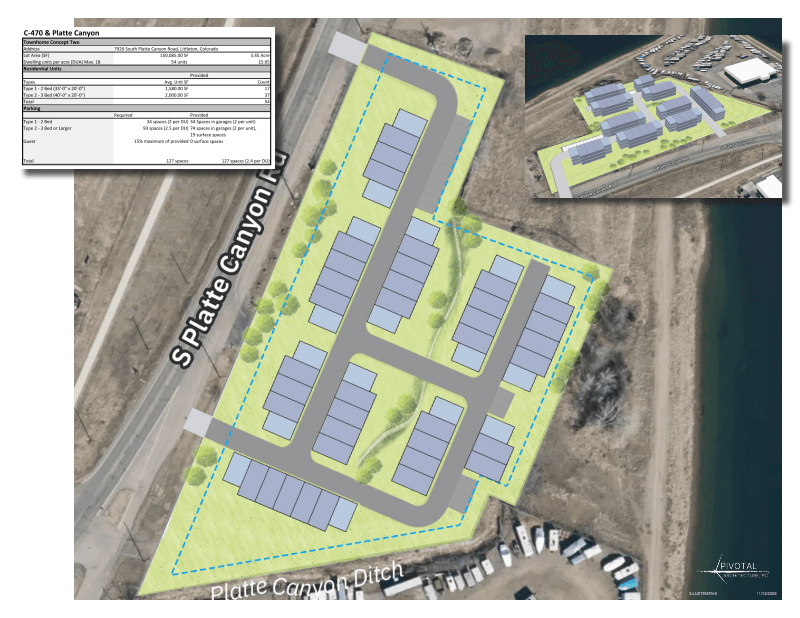
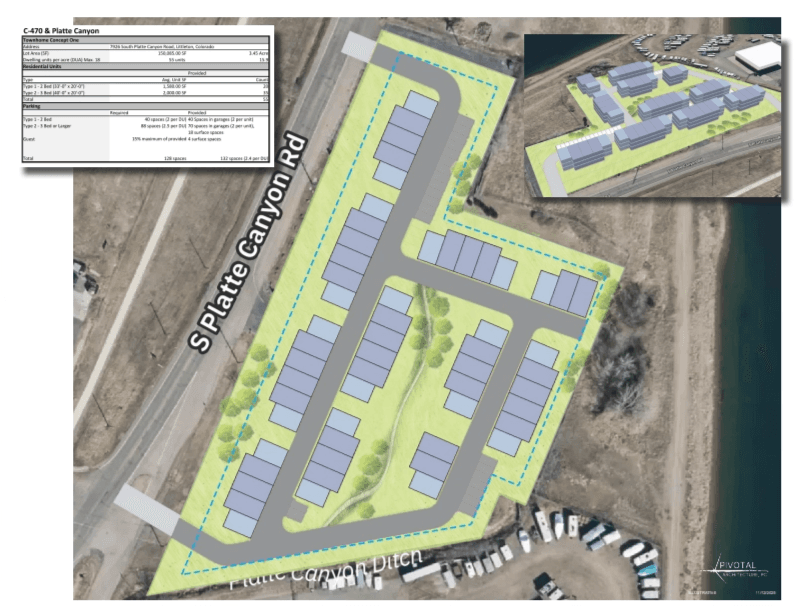
This scenario helped show how the land could support a more traditional attached residential format while still organizing circulation and parking in a functional way.
For developers evaluating land acquisition opportunities, this type of scenario is valuable because it provides an early understanding of achievable yield. Rather than relying on rough assumptions, the team could present a more visual and structured site planning option that helped communicate how the site could be developed.
Scenario 2: Active Adult Apartment and Condominium Concept
The second concept explored a higher-density active adult apartment or condominium strategy.
This option tested whether the site could support a more compact senior-oriented community with a mix of one-, two-, and three-bedroom homes, shared amenities, functional access, and parking.
Using Zenerate, Pivotal Architecture explored a concept of approximately 115 units. This scenario allowed the team to evaluate a very different development direction from the townhome option while using the same site.
%2520(1).jpg&w=3840&q=75)
%2520(1).jpg&w=3840&q=75)
The active adult concept helped illustrate how the site could support a denser residential community while still addressing practical site planning considerations such as access, circulation, parking, and amenities.
This was especially useful because developers are increasingly evaluating a range of housing formats based on market demand, land cost, and changing community needs. By comparing both townhomes and active adult housing, Pivotal Architecture could show multiple ways the site might create value.
The Result: Multiple Development Options in Hours Instead of Days
The main advantage of using Zenerate was speed.
Pivotal Architecture was able to generate and evaluate multiple development scenarios in hours rather than days. This allowed the team to move quickly from early site evaluation to client-ready marketing material.
The platform also helped communicate site yield more clearly. Zenerate's visual outputs made it easier to explain density, unit counts, circulation, and parking strategies to real estate stakeholders who needed to understand the site's potential.
For early-stage land planning, this is important. The faster a team can test multiple options, the faster developers can understand whether a site aligns with their goals.
Key Benefits for Pivotal Architecture
Zenerate supported Pivotal Architecture's workflow in several important ways.
First, the platform helped the team rapidly generate site planning options. Instead of spending days drafting initial layouts manually, Pivotal Architecture could produce multiple development scenarios much faster.
Second, Zenerate helped demonstrate site yield clearly. The platform's visual outputs made it easier to communicate approximate unit counts, density, parking, and site organization.
Third, Zenerate supported early land acquisition decisions. By showing what the site could potentially support, the team could help real estate stakeholders evaluate development opportunities earlier in the process.
Finally, the platform made it easier to test multiple housing types. For this project, Pivotal Architecture was able to compare a townhome strategy with an active adult apartment/condominium strategy, giving the client a broader understanding of the site's development potential.
Why Workflow Speed Matters in Early Land Planning
For architecture and land planning firms, early feasibility work is often time-sensitive.
Developers may be evaluating multiple sites at once. Real estate teams may need quick feedback before moving forward with acquisition discussions. Housing organizations may need to understand whether a site can support the right mix of units, parking, and community needs.
In these situations, speed does not replace design expertise. It supports it.
Zenerate helped Pivotal Architecture move faster through the early planning process while still applying professional judgment to site organization, housing type, density, and circulation. The platform provided a faster way to generate and compare options, while the design team guided the interpretation and presentation of those results.
This balance is especially important in real estate feasibility, where the goal is not simply to create a layout, but to understand what a site can realistically support.
How Zenerate Compared to Other Generative Site Planning Platforms
Pivotal Architecture has also evaluated competing generative site planning platforms.
From the firm's perspective, competing platforms often require more complex data entry before meaningful layouts can be generated. This can slow down early feasibility exploration, especially when the goal is to quickly test different site arrangements.
Once layouts are created, modifying them can also be difficult, and the user interface may become challenging when trying to quickly explore alternative planning strategies.
Zenerate offered a more streamlined workflow. The platform allowed Pivotal Architecture to generate and iterate site planning scenarios with less setup, making it easier to rapidly explore different development strategies such as townhomes and active adult housing.
For a firm working with developers and real estate teams, this flexibility is valuable. Early feasibility is rarely about one fixed answer. It is about testing possibilities, comparing trade-offs, and identifying which development direction is worth pursuing.
Final Thoughts
Pivotal Architecture used Zenerate to accelerate early-stage site planning for a suburban Denver metropolitan area site, generating and evaluating both townhome and active adult residential concepts in a matter of hours.
The workflow helped the team assess unit yield, circulation, parking, and development potential more quickly than traditional manual drafting. It also helped create clear marketing material for a large real estate company evaluating potential land acquisition opportunities.
For architecture and land planning firms, this type of workflow shows how AI-supported site planning can improve early real estate feasibility work. By generating multiple development scenarios faster, teams can spend more time evaluating strategy, communicating options, and helping clients make better land development decisions.
Explore What Zenerate Can Do
If you would like to discuss how Zenerate could support your feasibility or land development workflow, book a demo below to start the conversation. We also offer a feasibility report service through our partnership with Pivotal Architecture, where our team can prepare a detailed report tailored to your site. You can submit an application on our website to get started.
Book a Demo + Start a Free Trial