For decades, zoning rules have shaped what can be built, where it can be built, and how much housing a site can realistically support.
But across many U.S. cities, zoning reform is beginning to change the feasibility equation. Rules around minimum parking, height limits, lot sizes, density, and allowable housing types are being reconsidered as cities look for ways to address housing shortages and improve development viability.
For developers and architects, this means a real estate feasibility study can no longer rely only on static zoning assumptions. A site that looked constrained under older rules may become more viable under new zoning pathways, while projects in transitional regulatory environments may require more careful analysis.
Understanding how zoning reform affects multifamily feasibility is becoming an important part of early-stage land development strategy.
Why Zoning Reform Matters for Feasibility
Zoning regulations directly influence the physical and financial potential of a site. They determine allowable uses, building height, setbacks, density, parking, and sometimes the mix of unit types that can be delivered.
The American Planning Association explains that zoning reform is often used to address housing cost pressures by allowing more housing types, reducing minimum lot sizes, and reconsidering parking mandates. In its article, What Is Zoning Reform and Why Do We Need It?, APA notes that reforms such as allowing smaller units in larger structures and eliminating parking minimums can help improve density and reduce development costs.
For a development feasibility study, these rule changes matter because they can directly affect the project's achievable unit count, FAR, parking layout, and overall cost structure.
A change in zoning does not automatically make every site feasible. But it can expand the range of possible outcomes that should be tested during site feasibility analysis.
Parking Reform Can Change the Site Plan
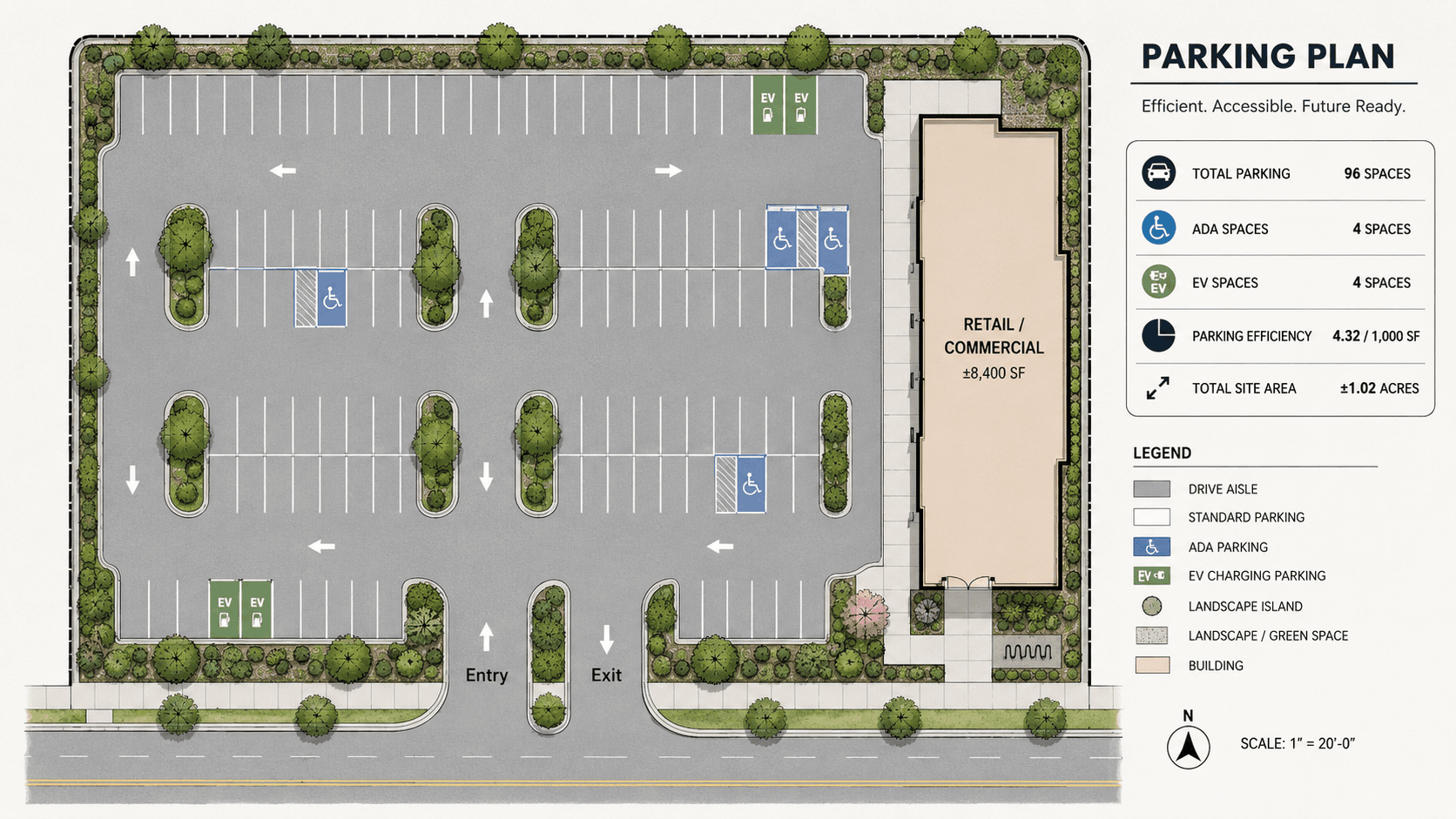
Parking is one of the clearest examples of how zoning reform affects feasibility.
Minimum parking requirements can reduce usable land area, increase construction costs, and limit the number of units that can fit on a site. The American Planning Association notes in The Push for Parking Reform that reducing parking requirements can lower housing costs, speed development, and increase supply.
For developers, this means parking reform can significantly change the outcome of a test fit.
If a site no longer requires the same number of parking spaces, the project may be able to support:
• More residential units
• Smaller or more efficient podiums
• More open space
• Lower structured parking costs
• Better circulation
NAIOP also highlights the financial impact of parking in its article Rightsizing Parking in Support of Sustainability and ROI, noting that surface parking can cost approximately $3,000 to $8,000+ per space, while multilevel parking structures can cost $25,000 to $100,000+ per space before land and operating costs are considered.
That cost range shows why parking assumptions should be tested early in a real estate feasibility study, especially in markets actively reforming parking rules.
Density and Height Changes Can Unlock New Scenarios
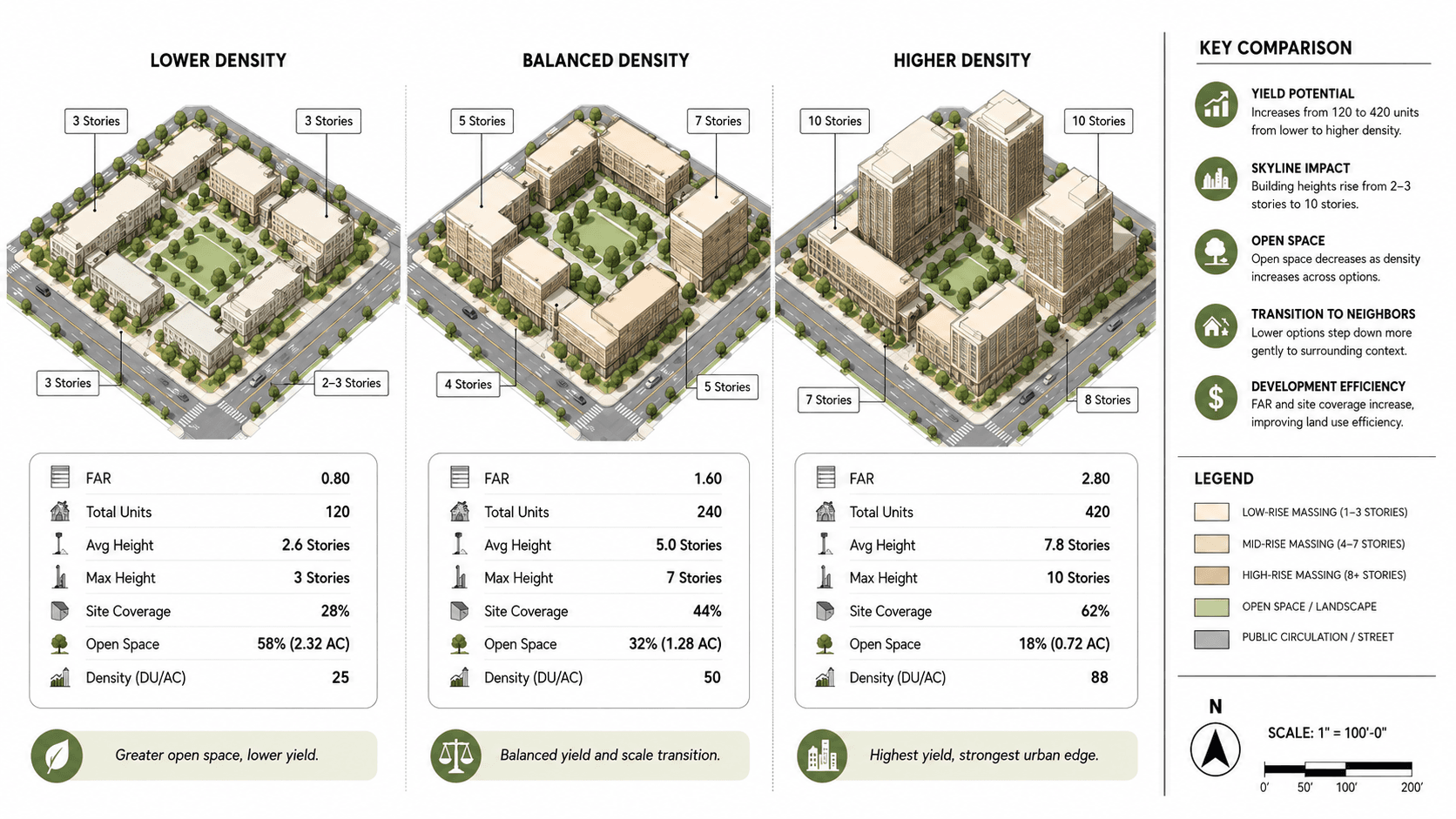
Zoning reform often focuses on increasing housing capacity by allowing more density, taller buildings, or more flexible housing types.
The Urban Land Institute discusses this in Zoning Reforms to Mitigate America's Affordable Housing Crisis, noting that reducing parking minimums, revising height restrictions, and allowing more housing types can help increase housing supply and improve development feasibility.
For multifamily feasibility, these changes can unlock new scenarios that were previously impossible under older zoning rules.
A site may support:
• Additional floors
• More units
• Higher FAR
• Different unit mix strategies
• A more efficient building envelope
However, higher density still needs to be evaluated carefully. A taller or denser project may require different construction types, different parking solutions, or more complex entitlement review.
This is why updated zoning analysis should be paired with iterative test fit modeling. The key question is not simply, "Can we build more?" It is, "Does the added density improve the project's overall feasibility?"
Smaller Units and Flexible Housing Types Can Shift the Unit Mix
Zoning reform can also affect the types of housing that are allowed on a site.
Some reforms allow smaller lots, accessory dwelling units, missing-middle housing, or more flexible multifamily configurations. Brookings has argued that improving housing affordability requires land use regulation that allows smaller, more compact housing, alongside other policy tools such as taxation and subsidies. See Brookings' article, To Improve Housing Affordability, We Need Better Alignment of Zoning, Taxes, and Subsidies.
For developers, more flexible housing rules can influence the development feasibility study by changing the unit mix strategy.
For example, a site that was previously limited to larger units or lower-density development may become viable with:
• Smaller average unit sizes
• More studio or one-bedroom units
• Missing-middle housing formats
• Mixed-use or ground-floor commercial components
These changes can affect rent assumptions, absorption strategy, parking demand, and construction efficiency.
A strong real estate feasibility study should evaluate how zoning reform changes not only the number of units, but also the type of units that make sense.
Reform Does Not Remove the Need for Feasibility Analysis
Zoning reform can improve development potential, but it does not eliminate risk.
Even when rules become more flexible, developers still need to evaluate site-specific constraints such as:
• Lot geometry
• Setbacks
• Topography
• Access
• Utility capacity
• Parking circulation
• Construction cost implications
This is where site feasibility analysis remains critical. A zoning change may increase allowable density on paper, but the actual site may still be limited by physical constraints or market realities.
The strongest approach is to use zoning reform as a starting point for deeper analysis, not as a final answer.
Why This Matters for Developers and Architects
As cities continue to update zoning rules, feasibility workflows need to become more dynamic.
A static zoning summary may not be enough. Developers and architects need to evaluate how changing rules affect massing, density, parking, unit mix, and financial performance together.
In practice, this means running multiple test fit scenarios under different assumptions:
• Existing zoning
• Proposed zoning reform
• Reduced parking requirements
• Increased height limits
• Alternative unit mix strategies
• Bonus or incentive pathways
This allows teams to compare what is technically allowed, what is physically possible, and what is financially viable.
Final Thoughts
Zoning reform is changing the way developers evaluate sites.
By reducing parking requirements, increasing density allowances, and enabling more flexible housing types, reform efforts can expand the range of feasible development scenarios. But those opportunities still need to be tested through detailed zoning analysis, site feasibility analysis, and iterative test fit modeling.
A stronger real estate feasibility study does not simply ask what the zoning code allows.
It asks how zoning changes interact with design, cost, market demand, and long-term project performance.
For developers and architects, that distinction is becoming increasingly important.
Explore What Zenerate Can Do
If you would like to discuss how Zenerate could support your feasibility or land development workflow, book a demo below to start the conversation.
Book a Demo + Start a Free Trial