The Personal Frustration That Sparked an Idea

Before founding Zenerate, CEO, Benji Shin, spent countless hours navigating the back-and-forth of feasibility studies. A typical project might involve days of work creating multiple design options, only to have the client ask for a different unit mix or other adjustments during the review. Those changes could stretch the process into weeks.
He often found himself asking the same questions: How can I serve my clients better? How can I work more efficiently? How can I find the most feasible design before multiple rounds of iterations?
These frustrations planted the seeds for what would eventually become Zenerate, a platform designed to remove bottlenecks in early-stage real estate development.
From Frustration to Innovation
The feasibility process, as he experienced it, was slow, iterative, and often frustrating.
"I usually spent a few days creating several design options… and when the client wanted changes, it could take days or even weeks to update." – Benji Shin
Q: What frustrated you the most about feasibility studies before founding Zenerate?
A: Lots of back-and-forth with clients. I usually spent a few days creating several design options, and when I met with the client for review, they often wanted to try a different unit mix or make various changes here and there. That could take days or even weeks on my end. I felt frustrated, constantly questioning how I could serve them better, work more efficiently, and complete the job faster.
Pinpointing the Industry's Weak Spots
The core problem isn't just slowness—it's the separation of design and finance in feasibility studies.
Q: From your perspective, what are the main shortcomings in how feasibility studies are conducted today?
A: The main shortcoming is that feasibility studies often aren't fully optimized because designs and financial analysis are done separately. Clients want to explore different options to find the best outcome, but right now, architects create designs without integrating financial performance, and clients run pro forma analyses afterward. This disconnect causes a lot of back-and-forth and means the process takes longer and rarely reaches the best possible solution, since architects never run the numbers themselves.
Why Speed Matters—But Isn't Enough
Testing more options quickly can give teams a competitive edge—but speed alone isn't the full answer.
Q: What do teams stand to gain by being able to test more options, more quickly?
A: Being able to test more options quickly means teams can explore better and more profitable solutions without delay. It saves time and reduces financing costs by enabling swift decisions, which is crucial because good properties don't stay available for long.
Q: Do you think fast feasibility reduces risk?
A: I don't think speed alone reduces risk. However, completing feasibility studies more thoroughly while exploring multiple options within a short timeframe definitely helps reduce risks—and that's exactly why we're building our product.
Balancing Speed and Thoroughness
Technology is breaking the old assumption that speed comes at the cost of depth.

"Speed and thoroughness can definitely coexist in early-stage real estate development analysis when using the right software." – Benji Shin
Q: Can speed and thoroughness really coexist in early analysis—or is that a myth?
A: Speed and thoroughness can definitely coexist in early-stage real estate development analysis when using the right software. The software can quickly generate a complete design package, eliminating manual tasks like counting parking stalls or units, which are time-consuming and prone to errors.
A Mindset Shift the Industry Needs
For Benji, integrating financial performance into design isn't optional—it's essential.
Q: What's one mindset shift you think the industry needs to make around early analysis?
A: I think early design must incorporate financial performance from the very beginning. Instead of treating design and finance as separate steps, integrating them early on ensures more realistic, optimized, and faster results. Only after incorporating financial performance early on can architects optimize their designs to maximize profits. This also saves clients a lot of time by reducing the back-and-forth usually needed to refine and improve the options.
Feasibility Then vs. Now
The past five years have brought a leap forward in feasibility capabilities—and AI is at the center of it.
Q: In your view, what does a "good" feasibility study look like in 2025—and how is that different from five years ago?
A: I hear from many of our architect customers that they now create and edit design options during client meetings to test various ideas and make quick decisions. Thanks to the arrival of generative design and AI feasibility tools, this has become possible—something that wasn't even imaginable just five years ago.
Looking Ahead
Benji predicts a future where generative design software and real-time data redefine the feasibility process entirely.
Q: How do you see the feasibility process evolving over the next 3–5 years, and what role will AI play in driving that change?
A: In 3–5 years, I believe everyone will be using generative design software for feasibility studies. There will be no need to dig through zoning documents, as all relevant information will be instantly available once you choose a site—something we have already implemented for LA's affordable housing developments. We will likely see CD-level drawings generated as early as the concept stage, thanks to advances in design automation, and modular construction could achieve this even sooner. Rents and construction cost data will also be integrated, with companies able to pull real-time figures for specific project types. This will open development opportunities to non-experienced investors with capital. Given how quickly technology is advancing, even this prediction might be underestimating how much the process will change.
The Zenerate Philosophy
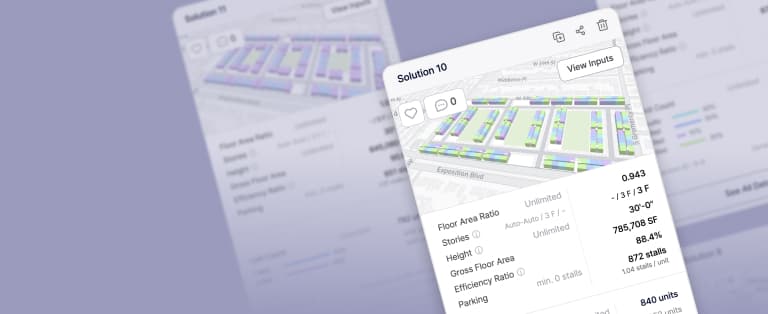
The company's approach began with consulting but scaled impact meant building a platform.
Q: What core assumptions did Zenerate challenge when rethinking the feasibility process?
A: When I started the company, my focus was not to build generative design software. My goal was to show that design and pro forma, with realistic premiums, should be integrated into the feasibility study process, as this could add 3% to 30% more profit compared to the traditional approach. In our first two years, through more than 50 projects, we helped clients achieve those additional profits. This was only possible through our consulting, but we wanted to make a global impact. That is why we shifted to building generative design software, with the plan to embed this core idea once the technology was ready.
Delivering Speed and Depth
AI-driven selection of algorithms could be the key to balancing efficiency with thorough analysis.
Q: How do you think platforms can deliver both speed and depth in feasibility—without compromising either?
A: This is actually a critical issue when deciding which generative algorithms to use for a site. It can take too much time to try out all the algorithms we have developed, yet there may be better options among the ones we do not select. In the end, I believe we can deliver both speed and depth by using AI to intelligently choose from our algorithm bank, ensuring the best results while maintaining fast delivery.
Final Thoughts
Early feasibility may be the most underrated phase in development, but it's also the one with the most untapped potential. With the right tools, teams can move faster, make smarter decisions, and unlock profits they didn't think were possible. At Zenerate, we're committed to making that the new industry standard.
Explore What Zenerate Can Do
Ready to accelerate your feasibility studies? Book a demo with us today and get a free trial to see how fast site planning can be done.
Book a demo + Get a Free Trial Button