AI is changing how real estate teams think about feasibility, site planning, and early development decisions. Developers can now evaluate more options faster, architects can explore design scenarios with greater flexibility, and land acquisition teams can begin testing site potential earlier in the process.
However, real estate development is not a simple text-based problem.
A site plan has to work spatially. A building has to fit within zoning constraints. A floor plan has to be usable. Parking, circulation, density, unit mix, FAR, and financial assumptions all need to connect in a way that supports real development decisions.
That is where Zenerate is focusing its next stage of growth.
In a recent conversation, Zenerate CEO Benji Shin shared his perspective on the future of AI in real estate development, how Zenerate’s vision has evolved, and why the company is moving beyond simple design generation toward optimized development scenarios.
Moving From Design Generation to Development Scenarios
When asked about the next stage of Zenerate, Benji pointed to a clear shift in focus. While the company has historically been known for design generation, its broader goal is to help users evaluate optimized development scenarios.
“While we've historically focused on design generation, we're now focusing on how to better generate optimized development scenarios. To solve this, we are developing various generative design algorithms that can factor in zoning constraints, massing options, and financial viability all at the same time, allowing developers to evaluate optimal site potential in minutes rather than weeks.”
This distinction matters.
For real estate developers, the value of a real estate feasibility platform is not only whether it can create a design option. The real value is whether it can help answer a more important question:
What is the best development strategy for this site?
That requires more than a single layout. It requires the ability to compare massing options, evaluate zoning constraints, review site yield, test floor plans, understand parking implications, and connect early design decisions to financial viability.
This is why Zenerate’s direction is increasingly focused on scenario-based feasibility. The platform is moving toward a workflow where developers and architects can evaluate multiple possible outcomes in minutes, rather than waiting days or weeks for manual studies.
How Zenerate’s Vision Has Evolved
Zenerate’s original mission has remained consistent: make feasibility studies faster, more accurate, and more accessible.
What has changed is the product approach.
“Our vision has always been making feasibility studies faster, more accurate, and accessible. What changed is how we achieve that. We’ve pivoted our business model and refined our product lineup as we learned how developers actually make decisions. We moved from static generative outputs to dynamic tools that give users complete control over design parameters.”
This evolution reflects an important lesson in the real estate development process.
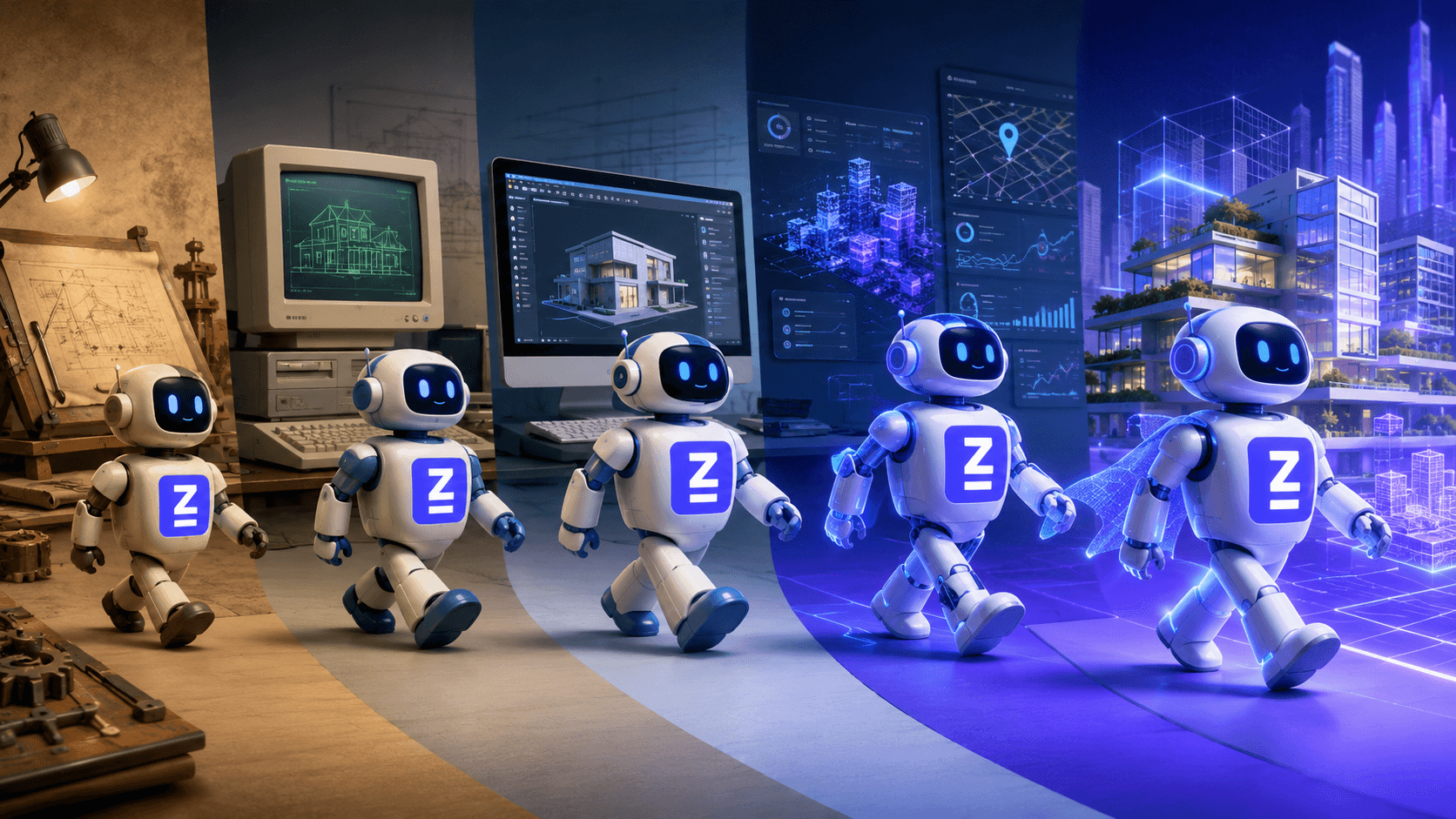
Developers rarely make decisions from one fixed output. They need to adjust assumptions, test alternatives, compare scenarios, and respond to new information. A site may look promising under one unit mix, but weaker under another. A higher-density option may improve yield, but create parking or circulation challenges. A zoning constraint may change the entire development strategy.
Static outputs are useful only to a point. Dynamic tools are more valuable because they allow users to continue shaping the study after the first result is generated.
That is why editing, parameter control, and scenario comparison are becoming central to Zenerate’s product direction.
Where AI Is Most Useful in Real Estate Development Today
AI is already useful in parts of the real estate development process, especially where complex information needs to be interpreted quickly.
Benji sees one of the clearest opportunities in zoning and regulatory analysis.
“LLMs have made parsing complex zoning codes and regulatory contexts drastically easier. The next frontier, where we operate, is taking that textual context and translating it into generative design to show what can actually be built on a specific parcel given those constraints.”
This is where the future of AI real estate feasibility software becomes more interesting.
Understanding zoning text is only the first step. The harder challenge is translating that zoning context into a buildable site plan. Developers need to know how zoning affects density, FAR, setbacks, parking, unit count, building form, and overall development potential.
In other words, the next stage of AI is not just reading the rules.
It is applying those rules to a specific site.
That is the space Zenerate is working in: connecting zoning inputs, site constraints, and generative design so users can better understand what a parcel can realistically support.
Why AI Is Still Misunderstood in Development
As AI becomes more visible across industries, expectations can become unrealistic. In real estate development, one of the biggest misconceptions is that AI can act as a complete “easy button.”
Benji pushed back on that idea.
“People often expect AI to be an ‘easy button’ that generates a fully buildable, fully permitted architectural set at the push of a button. In reality, current AI models struggle with complex geometric spatial reasoning, simply because they were not designed or trained to process spatial structures the way they process text. Real estate development requires a fundamental step-up in AI, specifically models tailored to handle spatial geometry and 3D constraints as natively as LLMs handle language.”
This is a critical point for the industry.
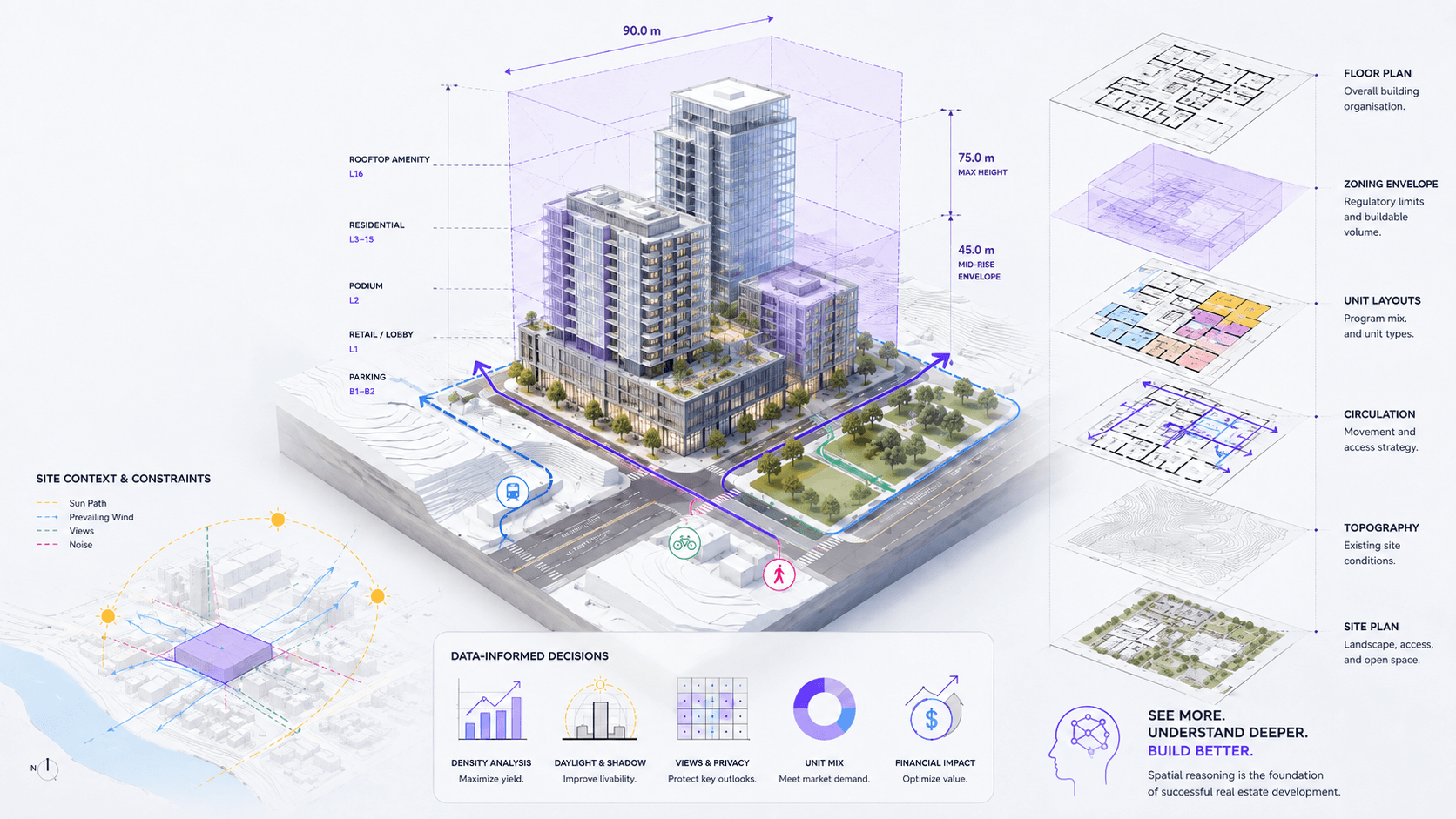
AI can produce text, images, summaries, and suggestions very quickly. However, real estate development requires spatial precision. A feasibility study cannot simply sound correct. It has to work geometrically.
A building has to fit. Units have to function. Parking has to be organized. Circulation has to make sense. Zoning constraints have to be respected. Financial assumptions have to connect to what is physically possible.
This is why real estate AI requires a different level of technical development. The challenge is not only generating an idea. The challenge is generating a spatially valid development scenario.
Why Spatial Reasoning Matters So Much
Benji has discussed spatial reasoning in previous interviews, and it remains one of the most important limitations AI needs to overcome in real estate development.
His explanation is direct:
“Without accurate floor plans, real estate development is a complete non-starter. Generating viable, buildable floor plans is the entire foundation of the process. That is why spatial reasoning matters so much, and why so many companies with this vision are actively chasing that goal.”
For developers and architects, this is obvious from experience.
A project cannot move forward if the floor plans do not work. Even at the early feasibility stage, the design has to provide a realistic basis for unit count, net rentable area, parking demand, circulation, and construction logic.
This is why test fit software for real estate development needs to do more than create an attractive massing study. It needs to help users evaluate whether a project can actually be developed.
Spatial reasoning is what connects the idea of a project to the physical reality of a site.
Why Editing Is Central to Zenerate’s Product Approach
AI generation alone is not enough for real estate development because every project has unique constraints. Even when a generated option is strong, it usually needs to be adjusted.
Benji compared this to how people already work with language models.
“Just like with an LLM where you edit the text output to match your specific intent, generative design works the same way. An algorithmically generated option is only the starting point. Real estate developers need to tweak unit mixes, adjust parking layouts, and refine building footprints. Giving users powerful editing tools lets them take AI-generated baseline designs and customize them to fit their exact project needs and strategy.”
This is one of the most important ideas behind Zenerate’s product direction.
The platform is not designed around the idea that AI should generate one final answer. Instead, it is designed around a more realistic workflow: generate a baseline, review the result, edit the design, adjust the assumptions, and continue refining the scenario.
This matters because development decisions are rarely fixed from the beginning. A team may need to change the unit mix, test a different parking layout, revise a building footprint, add amenities, or compare multiple site planning strategies.
Editing gives users control over the AI-generated output. It also keeps professional judgment at the center of the feasibility process.
Automation Should Handle the Heavy Lifting, Not Replace Judgment
One of the most important questions in the AI conversation is how automation should work alongside professional expertise.
For Benji, the answer is clear.
“Automation handles the heavy lifting such as calculating FAR, testing floor plans, and crunching yield metrics. Professional judgment guides the vision. We don't aim to replace the developer or architect; we aim to eliminate their grunt work so they can focus on high-value creative and financial decisions.”
This is a practical way to think about AI in development.
Developers and architects should not spend unnecessary time repeating manual calculations, redrawing similar options, or recreating early feasibility studies from scratch. Those tasks can slow down decision-making and limit the number of scenarios a team can review.
Automation can help remove that friction.
However, the judgment still belongs to the professionals. Developers understand deal strategy, market positioning, acquisition goals, and financial risk. Architects understand design quality, spatial logic, building performance, and how a layout should work.
Zenerate’s role is to support that expertise by making feasibility faster, more iterative, and easier to evaluate.
Zenerate as a Filter for Land Acquisition
Land acquisition is one of the areas where faster feasibility can create immediate value.
Before committing capital, developers need to know whether a site is worth pursuing. They need to evaluate capacity, understand yield, compare options, and identify risks early.
Benji described Zenerate’s role in this process as a filter.
“Zenerate acts as the ultimate filter during land acquisition. Developers can instantly stress-test parcel capacity, assess yield, and target only the most profitable deals before committing capital.”
This is where land development feasibility becomes a competitive advantage.
A developer may be reviewing multiple parcels at the same time. Some may look promising from location or price alone, but fail once zoning, parking, density, or floor plan constraints are tested. Others may reveal stronger potential only after multiple scenarios are compared.
By helping teams stress-test parcel capacity earlier, Zenerate can support faster and more confident land acquisition decisions.
The goal is not only to create a design. The goal is to understand whether the site deserves more time, attention, and capital.
What Comes Next for the Platform
Looking ahead, Benji is focused on improving both the intelligence of Zenerate’s generative engines and the flexibility of the user experience.
“I’m thrilled about advancing our generative design engines to handle increasingly complex urban infill sites and deliver more optimized site planning options. Equally high on my radar is refining our real-time editing features to make live collaboration and instant iteration completely seamless.”
This reflects two important directions for the company.
First, Zenerate is working toward more advanced generative design capabilities. Complex urban infill sites often involve irregular parcels, tight constraints, zoning complexity, parking limitations, and difficult site planning conditions. Handling these sites well requires stronger spatial logic and more optimized design generation.
Second, Zenerate is continuing to improve real-time editing and collaboration. Feasibility is rarely a solo process. Developers, architects, planners, and capital partners often need to review options together, adjust assumptions, and understand trade-offs quickly.
A stronger collaborative workflow can help teams move from static reports to live feasibility discussions.
The Long-Term Vision for Zenerate

Benji’s long-term vision is ambitious: make Zenerate the global standard for real estate feasibility.
“To become the global standard platform for real estate feasibility—the single environment where developers, architects, and capital partners collaborate to design, evaluate, and fund projects with absolute confidence.”
This vision positions feasibility as more than an early design step.
Feasibility is where design, finance, zoning, market strategy, and capital decisions begin to come together. If those stakeholders can work in one shared environment, the development process can become faster, clearer, and more coordinated.
For Zenerate, the opportunity is to become that environment.
A place where developers can evaluate site potential, architects can shape design options, and capital partners can understand project viability earlier in the process.
Final Thoughts
The future of AI in real estate development will not be defined only by faster generation.
It will be defined by whether AI can support better decisions.
For Zenerate, that means building tools that connect zoning constraints, massing options, spatial reasoning, financial viability, editing, and scenario comparison into one feasibility workflow.
As Benji Shin explained, AI still needs to improve in areas like spatial geometry and 3D constraints before it can fully support development decision-making. At the same time, the opportunity is clear: if AI can reduce repetitive work, accelerate feasibility studies, and help teams compare development scenarios faster, it can become a meaningful advantage for developers, architects, and capital partners.
Zenerate’s direction is centered on that future.
A future where real estate feasibility is faster, more collaborative, more dynamic, and more confident.
Explore What Zenerate Can Do
If you would like to discuss how Zenerate could support your feasibility or land development workflow, book a demo below to start the conversation.
Book a Demo + Start a Free Trial