Artificial intelligence is reaching an inflection point in the real estate industry. Breakthroughs in generative AI have demonstrated massive potential across the economy—for example, research by Goldman Sachs suggests AI advances could boost global GDP by 7% (nearly $7 trillion) in over a decade. Real estate, traditionally slower to digitize, is now rapidly catching up. As of 2025, architects, developers, and investors are experimenting with AI for design, construction management, and market analytics. Policymakers and industry groups are also paying attention, weighing ethical guidelines and skills training needs. In this article, we take stock of where AI in real estate stands today and offer data-backed predictions for 2026—including key trends, investment flows, looming challenges, and practical steps to stay ahead. The goal is to provide a clear roadmap of what to expect in 2026, so you can prepare to thrive in an AI-enabled real estate landscape.
Snapshot: 2025 Baseline
Adoption is underway but uneven. The real estate sector entered 2025 with AI usage expanding rapidly from its initial adoption phase. In architecture and engineering, roughly one-third of professionals worldwide now use AI tools daily, as stated by Ozgur Gungor from ARUP. A global survey of architects, engineers, and planners found 33% rely on AI every day (42% in the U.S.), and an overwhelming 80% of U.S. respondents are "very excited" about AI's potential in the built environment, as defined by Arup's global survey. However, formal integration of AI into business processes remains limited. An American Institute of Architects (AIA) study showed that only 8% of architecture firm leaders have fully integrated AI in practice so far (AIA). Most firms are still at the exploration stage—20% in active pilot implementations and another ~35% only considering or planning adoption as per AIA data. Individual architects mirror this early-stage usage: just 6% use AI regularly, while over half are experimenting with it in some form, based on Existing Conditions research. Nearly 53% of architects are trying out AI tools, 40% have only heard of AI (not yet using it), and a small portion remain unaware of it.
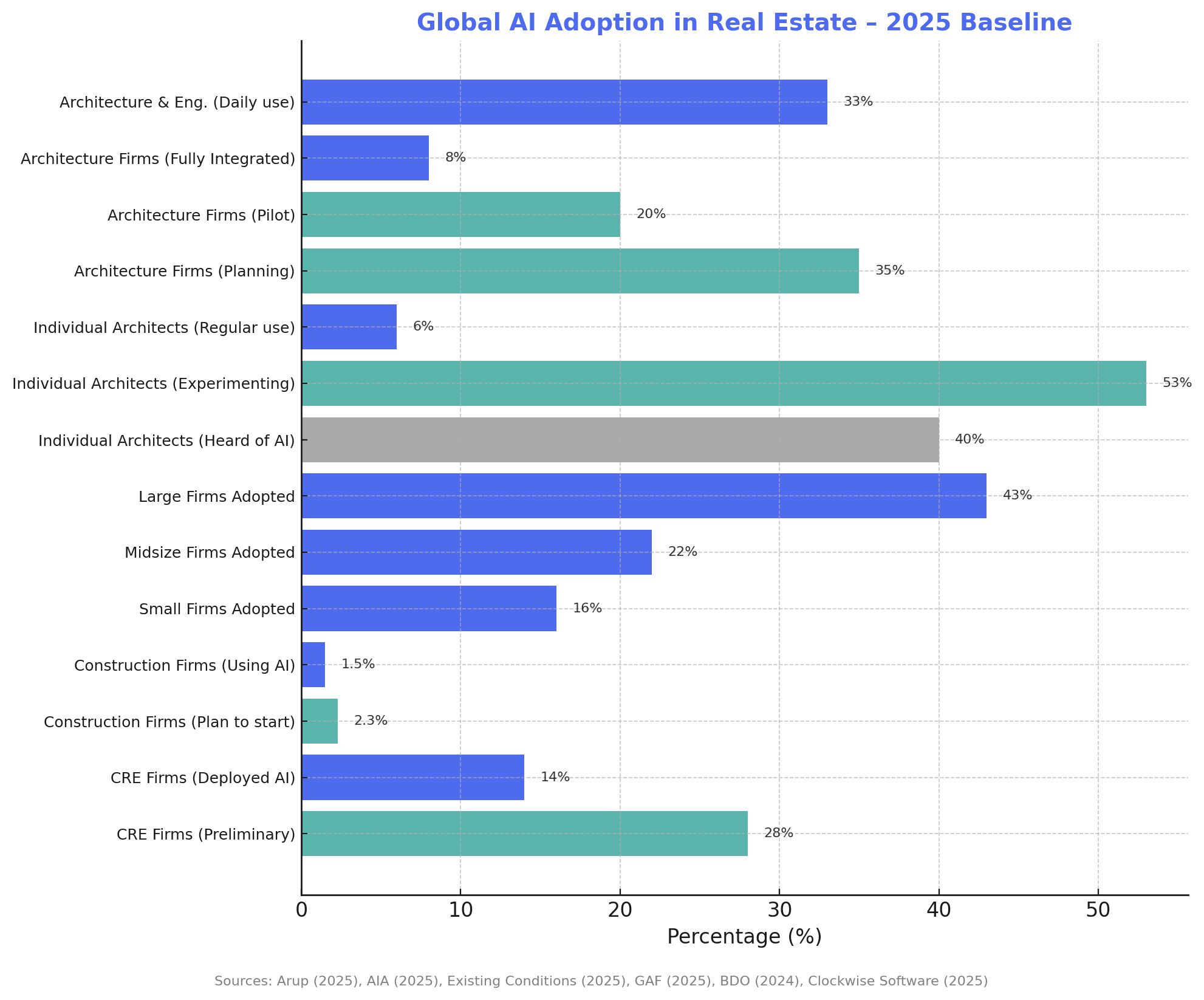
AI adoption among architects (2025 survey data). Over half are experimenting with AI tools, but only ~6% use AI regularly in daily work, according to Andrew Whipple (Existing Conditions). Most others have limited or no current use, reflecting that AI is still in early adoption stages in the architecture profession.
Adoption also varies by company size and sector. Larger organizations are leading the way: 43% of large architecture firms (50+ employees) have already adopted or are actively integrating AI into their workflows, compared to 22% of midsize firms and just 16% of small firms, as reported by the GAF industry report. This is typical of new tech adoption curves—bigger firms have more resources for technology pilots and training. Construction companies, on the other hand, are lagging.
A 2024 industry analysis found that only ~1.5% of U.S. construction firms had recently used any AI, and just 2.3% expected to start using AI in the near future, as explained by BDO's analysis. Many builders remain wary, citing uncertainty around AI's uses and risks as a main barrier. Similarly, according to Clockwise Software, only 14% of companies have deployed AI in any capacity so far (another 28% are in preliminary implementation) in the commercial real estate sector, even though more than half of industry leaders recognize AI as one of the most important emerging technologies for the next five years.
Share of architecture firms adopting or implementing AI (by firm size, 2025) per GAF research. Larger firms are far ahead in leveraging AI tools, while most small studios have not yet begun. This gap highlights the resource and expertise advantages that big firms currently have in AI adoption.
Current use cases and momentum. Where AI is being used in real estate today, it's often for narrow, supportive tasks. Architects report using AI-driven tools for visualizations and concept ideation (e.g., generative image tools), text drafting (such as ChatGPT for proposals or reports), and speeding up documentation tasks, based on AIA and RIBA findings. In construction, early adopters apply AI for predictive analytics, forecasting project delays or cost overruns from past data, and for safety monitoring (computer vision that detects, for example, whether workers are wearing protective gear), according to Surety Bond Professionals.
Real estate investors and brokers are tapping AI for market research, using machine learning to sift through property data and even to generate property listings or marketing materials automatically (Clockwise Software). Notably, many design/engineering professionals have moved beyond just chatbots: in one survey, conducted by Arup, technical AEC experts were using machine-learning predictive models, physics-based simulations, and "evolutionary" generative algorithms to tackle complex design and urban planning problems. This suggests that in segments of the industry, AI is already creating real value by optimizing energy models, generating design options, and automating routine work. Notably, 91% of surveyed AEC professionals agree that clear ethical guidelines are needed to guide AI's use in the built environment (Arup), indicating that adoption has grown enough to warrant formal governance.
Importantly, the momentum is accelerating. In 2024, corporations worldwide invested an estimated $252 billion into AI-related research and projects (Arup). Venture capital funding in real estate tech has increasingly flowed toward AI-enabled startups (for instance, startups offering AI-powered property valuation, tenant screening, or construction robotics). A majority of architecture/engineering firms plan to boost tech spending, as found in Deltek's 2025 tech trends report; 79% of AEC firms said they will increase investment in AI and cybersecurity tools in the coming year. A compelling 78% of firms believe they'll lose market share within two years if they fail to make progress in digital transformation (Deltek).
Predictions for 2026: AI-Driven Design Goes Mainstream
By 2026, using AI in architectural design and planning will shift from unfamiliarity to normalcy. We predict that a majority of large architecture and engineering firms will routinely use generative AI and machine learning tools in their design process. This is a natural progression of current trends: as of 2024, 41% of architecture practices were already using AI at least occasionally (RIBA), and leaders expect "tangible benefits" from wider integration in the near term. Firms like Cove.tool (an Atlanta-based startup recently described as the first AI-powered design firm) have demonstrated that entire building projects can be optimized using AI for energy modeling, code compliance, and more (Existing Conditions).
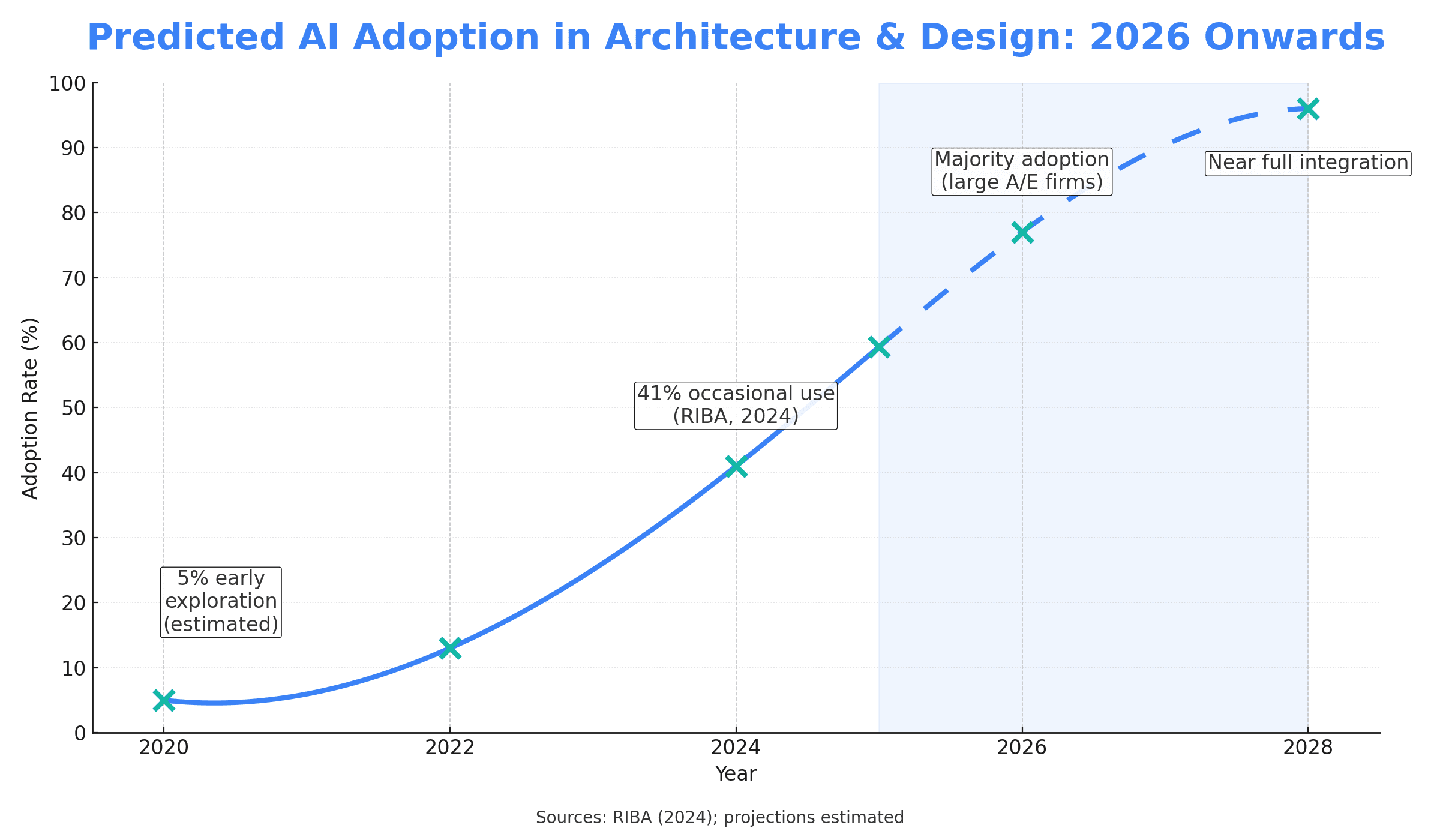
By 2026, many new buildings will be "AI-assisted" by default—generative design software suggesting floor plans, AI code-checkers reviewing drawings, and algorithms optimizing material use for cost and sustainability.
Impact: Architecture and development teams will achieve faster design iterations, lower costs, and improved building performance. Rather than replacing creativity, AI is expected to augment architects' creativity. As one industry expert put it, "the future of architecture isn't about AI replacing human creativity—it's about AI enhancing it," by automating routine tasks and freeing architects to focus on high-value design work (Existing Conditions). Early evidence backs this: firms using AI have reported 25%+ productivity gains in specific tasks (Goldman Sachs).
Action: Firms should invest now in training designers on AI-driven design platforms and integrating those tools into workflows. Pilot projects (for instance, using an AI generative tool on a small project's concept phase) can build internal expertise. Also, firms should establish guidelines for AI usage (e.g., require human review of AI-generated outputs) to maintain quality and professional standards even as AI tools become everyday aids.
Construction Sites Embrace AI and Automation
In 2026, we expect AI adoption in construction to accelerate, moving from back-office pilots to on-site implementation. Today's low adoption (only ~2% of contractors use AI, per BDO findings) will begin to climb as success stories emerge. For instance, computer vision AI that monitors jobsite safety in real time is likely to see broader rollout, given its promise in reducing accidents—one system can identify missing hard hats or harnesses via site cameras and alert supervisors. Likewise, AI-driven project management, such as algorithms optimizing schedules and flagging likely delays, will become a standard module in construction software.
Why it's likely: The construction sector faces chronic challenges, such as labor shortages, cost overruns, and safety issues, and AI solutions are maturing to address these. Executives are increasingly convinced of AI's benefits: 68% of construction leaders believe AI will improve the industry even though many haven't acted on it yet, according to Autodesk. Moreover, tech giants and startups are introducing accessible tools, for instance, automated progress tracking via drone imagery and AI.
By 2026, we expect leading contractors to use AI for predictive maintenance of equipment, automated quality inspections for AI-driven image recognition to spot defects, and supply chain optimization, among other uses.
Impact: Early-adopting construction firms will gain a productivity edge—projects completed faster and with fewer costly errors. AI-enhanced scheduling and budgeting can trim waste and contingency costs, improving margins. Safety AI could reduce injury rates, which also has bottom-line benefits, including lower insurance and downtime.
Action: Construction companies should start with small with high-impact AI pilots. A sensible first step is applying AI to back-office or planning tasks (e.g., using an AI scheduling assistant or cost forecast tool) where implementation is straightforward and risk is low (BDO). Investing in educating project managers about these tools is critical. Additionally, begin capturing and centralizing project data now—AI feeds on data, so improving data collection through site sensors, drones, and unified software is essential and will pave the way for effective AI deployment. Firms that build an internal culture of data and innovation by 2026 will be well-positioned to reap AI's rewards as the tech matures.
Data-Driven Dealmaking & Property Management Become Standard
Real estate investors, brokers, and property managers will increasingly rely on AI analytics by 2026, making data-driven decision-making the norm. We foresee wider use of AI for underwriting deals (e.g., algorithms that analyze millions of data points to identify undervalued properties or predict emerging market trends). Already, large asset managers are experimenting with machine learning models to forecast property values and rents more accurately than traditional models, according to Clockwise Software.
By 2026, these predictive models will be more widely adopted in investment firms and even regional brokerage operations. On the property management side, AI chatbots and voice assistants are expected to handle a large share of tenant inquiries and maintenance requests.
Why it's likely: The volume of real estate data (from IoT building sensors, smart leases, market databases) is exploding, and AI is uniquely suited to turn this "big data" into insights. Companies that leverage AI analytics have seen benefits—one real estate brokerage reported doubling commission revenue by using AI to identify likely sellers before competitors (Clockwise Software). Moreover, 54% of real estate companies say AI will be among the most important tech tools in the next five years.
Impact: Participants in the real estate market who use AI will make faster, smarter decisions. Investors using AI-driven models may consistently beat those using gut instinct or manual spreadsheets, as market shifts or risks, like tenant default probabilities, can be anticipated sooner. Tenants and customers will also notice improvements—expect more personalized services as AI can recommend properties to clients based on their preferences, or adjust building HVAC settings based on occupant patterns.
Action: Real estate firms should invest in data infrastructure and skills. This means cleaning and unifying your data (e.g., on properties, leases, and clients) so that AI algorithms can be applied effectively. Firms may consider hiring data scientists or partnering with PropTech providers to develop AI models tailored to their portfolio. In property management, start integrating AI-powered chatbots or maintenance platforms on a trial basis; these systems can learn and improve over time.
Market Realignment of AI Startups and Surge in Strategic Partnerships
The year 2026 will likely witness a shakeout in the AI startup ecosystem, especially in the PropTech domain, but also a wave of consolidation and partnership as mature real estate firms snap up AI capabilities. The hype around AI in 2023–2024 led to hundreds of new startups, many building niche "AI-powered" tools for real estate. By 2026, we anticipate that only the startups providing genuine value with proprietary technology or strong customer traction will survive.
Industry observers have drawn parallels with the dot-com bubble: currently, "AI-powered" is sometimes just a buzzword, with many products essentially wrappers around the same large language models, as stated in a Skool of Life analysis. As the analysis quipped, these startups are often little more than "prompt pipelines stapled to a UI," lacking defensible IP. When the venture funding frenzy cools, a predicted 99% of AI startups will be gone by 2026 as unsustainable companies collapse (Skool of Life).
Impact: For real estate practitioners, this upheaval means two things:
1. Some AI tools you might be trying could disappear or get acquired.
2. The AI solutions that do persist will be more stable, likely offered by well-capitalized firms.
We expect to see large real estate service companies and software vendors acquiring AI startups to fold their tech into robust platforms. In 2025, there were already signs of this consolidation, and by 2026, any major brokerage or property management software without AI features will be an outlier.
Action: Be selective and strategic in choosing AI solutions. During this period of flux, pilot multiple tools but avoid overcommitting to any single unproven vendor. Favor products from established companies or those with clear case studies in real estate. If you're investing in or partnering with an AI startup, do thorough due diligence on their technology and ensure it's not solely dependent on a third-party AI that you could access yourself (Skool of Life).
New Regulations and Ethical Standards Take Hold
By 2026, we forecast the governance of AI in real estate to have advanced significantly. We anticipate the introduction of industry standards and possibly regulations in certain jurisdictions around the ethical use of AI for things like property marketing, tenant selection, and loan underwriting.
Several factors drive this:
• The EU's AI Act and other emerging laws could classify real estate algorithms, for example, AI used in mortgage lending or tenant screening, as "high-risk," forcing companies to implement compliance measures like transparency, bias testing, and documentation.
• Professional bodies are pushing for guidelines—82% of architects surveyed want an official AIA charter on responsible AI use in architecture (GAF industry report).
Impact: Real estate firms will need to be more disciplined in how they deploy AI, but this will build trust and reduce risks. Without ethical guardrails, AI could unintentionally perpetuate discrimination—e.g., an AI model might bias tenant recommendations or property valuations if trained on biased historical data.
Action: Proactively implement AI governance within your organization. Develop internal AI ethics policies covering responsible data use, bias monitoring, and human oversight. If you use an AI model to screen rental applications, routinely audit its recommendations for any bias and keep a human in the loop for final decisions. Train staff on AI's limitations and require that all AI outputs be verified before use (Existing Conditions).
Investment & Adoption Trends in 2026
In 2026, we expect to see investment capital continuing to flow robustly into AI for real estate, but with a more targeted focus. Funding is likely to concentrate on startups offering concrete solutions like AI-powered energy management (to meet sustainability targets) and construction robotics/automation, rather than on broad "AI for real estate" concepts.
Regional adoption trends:
• United States: Leads in AEC AI usage with 42% of U.S. architects/engineers using AI daily vs ~33% globally (Arup).
• Asia-Pacific: Poised to leapfrog in targeted AI use cases, underpinned by national smart-city programs (e.g., ASEAN Smart Cities Network) and government AI strategies; APAC AI spend is forecast to reach $175B by 2028, and developing economies show higher GenAI uptake than developed ones (IDC).
• Europe: Adoption might be tempered by stricter regulations, but leading firms will invest heavily, especially in sustainability-focused AI.
We also expect record levels of M&A activity, where large tech firms and real estate service companies acquire AI startups. The result will be fewer, larger vendors offering end-to-end AI solutions embedded into standard real estate software.
Another major trend will be the "stealth adoption" of AI; users won't always realize they're using it. AI will be baked into tools like CAD programs, property CRMs, and project management apps, providing automated insights by default.
Risks & Challenges to Watch For
Even as AI becomes more prevalent in real estate, several risks and challenges must be managed in 2026:
1. Data Quality & Bias
AI systems are only as good as the data fed into them. Real estate data can be notoriously fragmented and inconsistent, which can hinder AI effectiveness, according to Surety Bond Professionals. Poor data can also embed biases—e.g., if an AI leasing tool is trained on historical tenant data that reflects discriminatory practices, it may perpetuate those biases. Companies will need to invest in data cleaning and monitor AI outputs for fairness. Tools and processes to audit AI decisions, especially for lending or tenant screening, are crucial to avoid legal and ethical pitfalls, according to GAF.
2. Privacy & Security
Many AI applications require large amounts of data, including sensitive information about properties, clients, or employees. This raises privacy concerns as using occupant data to train an AI could violate privacy laws if not handled properly. Cybersecurity is also a concern: AI could become a target for hackers. Firms will have to ensure compliance with data protection regulations and implement robust security for AI platforms. 93% of architects in one survey cited privacy and security as a top worry regarding AI (Existing Conditions).
3. Regulatory Uncertainty
Regulations around AI are evolving. By 2026, new rules may directly impact real estate with constraints on automated property valuations or on using AI in hiring decisions for construction staffing. Until those rules are clarified, organizations face uncertainty. Overly restrictive rules could slow innovation, while a lack of regulation could expose firms to reputational risk.
4. Integration & Talent Gap
Implementing AI is not plug-and-play. Many real estate companies use legacy systems that don't easily connect to new AI solutions (Surety Bond Professionals). There is also a skills gap where teams may lack expertise in data science and AI. Hiring and upskilling will be vital to mitigate this.
5. AI Output Errors (Hallucinations)
Current AI, especially generative models, can produce incorrect or nonsensical outputs—known as "hallucinations." In architecture or planning, such errors could be dangerous if not caught immediately. 94% of architects surveyed voiced concern about inaccuracies, according to AIA. This, in turn, underscores the need for human oversight and review processes.
Staying Ahead of the Curve: A Practical Playbook
To capitalize on AI in 2026, real estate organizations should take proactive steps now:
1. Invest in Upskilling Your Team
Build AI literacy at all levels. Encourage training in relevant tools and consider workshops or certification programs.
2. Start with Focused Pilot Projects
Identify 1–2 areas where AI can quickly add value. Keep scope narrow, set success metrics, and scale successful pilots.
3. Strengthen Your Data Foundation
Audit and improve data collection/management now. Remove barriers between systems, adopt standards, and invest in cleaning and labeling historical data.
4. Choose Partners and Tools Wisely
Opt for reputable platforms with transparency. Pilot software before committing and avoid long-term contracts with unproven vendors.
5. Implement AI Governance and Ethics Policies
Establish guidelines for privacy, bias avoidance, and human oversight. Require verification of AI outputs before client use (Existing Conditions).
By executing these steps, companies can position themselves to ride the AI wave rather than be overwhelmed by it.
Key Takeaways and Next Steps
The year 2026 is poised to be a breakout moment for AI in real estate, a year when the technology moves from promising pilots to industry-wide adoption. Early adopters stand to reap significant rewards: streamlined operations, smarter investment decisions, safer and more efficient projects, and innovative services that differentiate them in the market. Those who ignore the trend risk falling behind in productivity and competitiveness.
The message is clear: 2026 will reward the real estate players who are prepared, proactive, and open to innovation. That preparation starts now. Real estate firms should be laying the groundwork in 2025—educating teams, investing in data and pilot projects, and engaging with experts—to ensure they can leverage AI responsibly and effectively in the coming year. The window to act is wide open.
Is your organization ready to harness AI's potential in 2026? Whether you're looking to implement AI-driven design, automate your construction workflows, or gain predictive insights into your portfolio, taking the next step is crucial. We invite you to get ahead of the curve—contact us for a consultation or request a demo to see how the latest AI solutions can be tailored to your business. By exploring these technologies now, you can enter 2026 with confidence, equipped with the tools and strategies to thrive in the new era of AI-powered real estate. The future is coming fast; let's embrace it and build a smarter, more successful real estate industry together.
Explore What Zenerate Can Do
Ready to accelerate your feasibility studies? Book a demo with us today and get a free trial to see how fast site planning can be done.
Book a demo + Get a Free Trial Button